




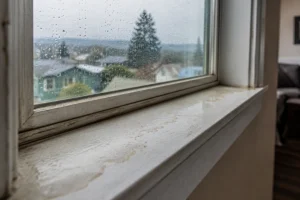
When a Window Leak Becomes a Serious Problem
It always shows up after a long stretch of rain. A dark ring on the sill. A patch of wall that feels cooler than it should. You wipe it down, tell yourself it is nothing, and then it comes right back.
A window leak rarely announces itself. Here in Seattle, where the rain runs from October clear through spring, water gets months to test every seam around your windows. It finds the tired caulk, the worn seal, the spot where the frame quietly stopped doing its job a while ago.
Left alone, a small drip turns into water damage around the window frame, then mold, then soft wood inside the wall. That slide happens faster than most homeowners expect. This guide walks through the warning signs worth catching early, before a quiet leak becomes an expensive one.
Discoloration and Stains Around the Window Sill
Color is usually the first thing you notice. A window sill leak tends to leave a stain before it leaves a puddle, and the shade tells a small story. Yellow or tan means the water is fresh and ongoing. Brown or copper means it has been soaking in for a while.
A stained window sill plays tricks on you. The mark fades when things dry out, then darkens again after the next storm. If you see water on the window sill when it rains and a ring that keeps returning, the source is still active.
Here is what most people get wrong. They paint over it. Fresh paint hides the stain for a season, but it does nothing to the water sneaking in behind the trim, so the mark bleeds right back through.
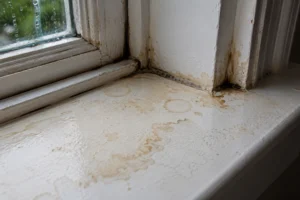
We see this one a lot. A homeowner paints over the same sill spring after spring while the water behind the trim keeps working, and eventually the wood underneath goes soft. Paint hides the stain. It does nothing to the leak.
Peeling Paint, Bubbling Drywall, and Warped Trim
When water keeps working at a wall, the paint gives up first. Moisture breaks the bond between paint and surface, so you get bubbling, flaking, or little blisters near the frame. A leaking window frame with drywall peeling beside it tells you the wall is staying wet, not just getting wet once.
Press the drywall around the window with your thumb. If it feels soft, spongy, or gives a little, water has worked into the board itself. Water damage on the window sill often spreads sideways into the wall before anyone connects the two.
Trim shows it too. Casing can bow, cup, or pull away from the wall after months of damp, leaving gaps you did not used to see.
Musty Odors Near Windows
Sometimes you smell it before you see it. That damp, wet-cardboard smell near a window means moisture is trapped inside the building materials around it.
Your nose is early here. A musty odor usually shows up before any mold is visible, because the growth starts inside the wall or under the sill where you cannot see it. If a room smells like an old basement and one window is the common thread, treat that as a signal.
Mold Growth on and Around the Window
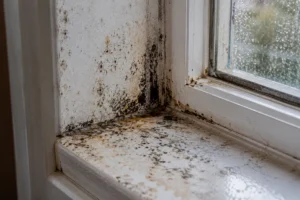
Mold is the sign that stops people in their tracks, and it should. It turns up in a range of colors, and homeowners ask us about all of them. Brown mold on a window sill, orange mold on a window sill, that fuzzy yellow mold on a window sill, plus the more familiar black and green spotting on the wall nearby.
The color matters less than what it tells you. Mold needs steady moisture to grow, so any of it means the leak is ongoing. And not a one-time splash from a window left open in the rain.
There is a health side too, worth a quick word. Mold puts spores into the air that can set off allergy-type symptoms, sneezing, congestion, itchy eyes, especially for anyone in the house with asthma. No need to panic. Just do not let it sit.
Visible Water Pooling and Accumulation
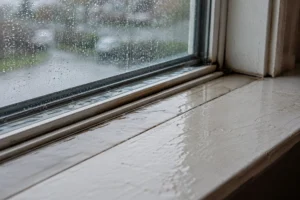
No guesswork with this one. When the window sill fills with water, or you find water in the window track after a storm, the leak has gone from suspected to confirmed.
The test is simple. Was the window shut? If the window was closed and water still came in during the rain, that is a window leaking from the bottom sill. DO NOT mistake that for a draft or fog on the glass.
Water leaking under the window sill is the version you might miss, because it runs down behind the trim instead of pooling where you can see it. And water that sits in the track does real harm over time. It works into the frame corners and speeds up rot in the exact spot that holds the whole unit square.
Floor Damage Near Windows
Water always heads down. So when a window leak runs long enough, the floor below it pays the price, and the damage often shows up a foot or two from the wall where nobody is looking for it.
Watch for cupped or warped hardwood, planks lifting at the seams, tile gone loose underfoot, or linoleum peeling up near an exterior wall. Window sill water damage that reaches the floor is a sign the leak has been running for a while.
Here is the trap. Water damage under the window gets blamed on a plumbing problem more often than not, so folks chase a pipe that turns out bone dry while the real culprit sits right above the baseboard. Rule out the window first.f
Explore More: Will Replacing Windows Lower My Energy Bill
Sagging Ceilings and Hidden Wall Damage
Some leaks hide in the wall cavity for months before they surface. By the time the evidence reaches you, water has already soaked the drywall and the framing behind it.
A leak above a window can travel down inside the wall and pool where two surfaces meet, which is why a sagging or bulging ceiling near a window deserves attention right away. So does that strange yellow stuff dripping from walls, a sticky amber residue that is basically concentrated water stain leaching out of saturated drywall.
Treat this stage as urgent. Hidden water that has had time to spread is the kind that becomes a framing repair, not a quick fix.
Read more information on Top 10 Window Installation Mistakes
Condensation vs. a Real Window Leak
Not every wet window is a leak, and this is where homeowners talk themselves into worrying or out of it, both at the wrong times. Water on the inside of the windows is often just condensation, normal on a cold Pacific Northwest morning when warm indoor air meets chilly glass.
So how do you tell them apart? Condensation sits on the glass and wipes away clean. A real window leak leaves water lower down, on the sill, in the track, or running onto the wall.
The timing gives it away, too. If the water shows up reliably during or right after rain, and lands on the sill rather than the glass, you are looking at a leak.
Read for more better understanding: Why Are My Windows Fogging Up?
FAQs
Why does my window sill leak when it rains?
When a window sill leaks when it rains, water is getting past a worn seal, dried-out caulk, or a clogged drainage hole and collecting on the sill. Rain just makes an existing weak point obvious. The gap was always there waiting.
What causes water to come in under the window sill?
Water coming in under the window sill usually means the seal at the bottom of the unit, or the flashing behind it, has failed. Instead of draining away from the house, the water gets pushed inward and surfaces below the sill, sometimes a little distance from where it actually got in.
Is a small window leak something I can ignore?
No, and that is the honest answer even if it is not the fun one. A small leak feeds the same rot and mold a big one does, just slower. In our climate it rarely stays small for long, because the rain keeps coming back to feed it.
How do I know if my window needs repair or full replacement?
It depends on what is failing. A cracked bead of caulk or a single bad seal can sometimes be repaired. Once the frame is rotting, the wood is soft, or the same window leaks year after year, replacement is usually the more honest fix. A professional window replacement can tell you which camp you are in.
Can a window leak cause mold inside my walls?
Yes, and it happens more than people think. Water that slips behind the trim can feed mold inside the wall cavity, where you never see it and only smell it. That is why a musty odor with no visible mold still earns a closer look.
Do Not Wait on a Window Leak
Run back through the signs and a pattern shows up. Stains that return, paint that bubbles, a musty smell, mold in odd colors, pooling water, warped floors, a sagging ceiling. Any one of them can point to a window leak, and the earlier you catch it, the smaller the repair.
A leaking window sill is not a problem that waits politely. Seattle hands your windows months of rain at a stretch, so a water damaged window sill today can be a soft frame and a wall repair by next winter if it gets ignored.
If you are not sure whether you are looking at a quick seal fix or a window that has reached the end of the road, that is exactly what our free in-home assessment and Window Replacement Cost sorts out. There is no pressure, and a good estimator will tell you straight if a repair makes more sense than a replacement. Better to know now, while it is still small.